


Real estate valuation in ski resorts: method, criteria and advice
Property Valuation in Valloire and Valmeinier: How to Value Your Property in a Ski Resort
Estimating the value of a property in a mountain resort is not simply a matter of applying an average price per square metre.
In the same resort, two apartments of similar size can have very different values depending on their location, orientation, view, condition, access to the slopes, condominium status, outbuildings and rental potential.
Today, numerous automated valuation tools can provide an initial indication of price. These tools can be useful for understanding general market trends, particularly thanks to real estate transaction databases.
The public DVF service, for example, allows users to consult land data from the last five years, including sale prices, transaction dates and certain characteristics of the properties sold.
However, caution is required when using these tools: a reliable valuation requires a much more detailed understanding of the market.
This is precisely where the expertise of a local professional becomes invaluable.

A Valuation Begins with a Detailed Analysis of the Property
The first step is to study the property’s specific characteristics:
- Living area and/or Carrez law area
- Location and accessibility
- Interior layout, circulation, space optimisation and storage
- Overall condition and age of the property
- Quality of fixtures and fittings
- Orientation, natural light, views and overlooking
- Outdoor spaces: balcony, terrace or garden
- Outbuildings: cellar, ski locker, garage, parking space, relaxation area, etc.
- Maintenance costs
- Energy performance
- Legal status: freehold ownership, commercial lease, standard condominium or tourist residence
- Size of the condominium
- Renovation work required
All these elements are of considerable importance. A well-oriented freehold apartment with parking and easy access to the slopes can be valued significantly higher than a property of the same size that is less convenient to use.

Location: A Determining Factor
In a ski resort, location is not just about an address. It is essential to understand how the property is actually used.
An apartment located in the heart of the resort, close to shops, amenities and a ski lift, does not meet the same needs as a property in a quieter hamlet further from amenities.
That is why a reliable appraisal cannot be based solely on the average local price.
It must take into account the specific characteristics of the location, ease of access, proximity to ski lifts, parking and shuttle services.

Market References
Selling Prices, Asking Prices and Competing Properties
A sound property valuation in a ski resort, whether in Valloire or Valmeinier, relies on several levels of comparison.
First, it is important to consider actual sales. Notarial databases provide useful references on past transactions.
Next, properties currently on the market must be analysed. However, an online listing price is not necessarily a fair market price.
Some properties are well positioned, while others are overpriced and remain on the market for extended periods.
A local professional knows how to distinguish between an asking price, a negotiable price and a price that is truly likely to generate a sale.
An agency is also well positioned to take real demand into account: the budgets of active buyers, the most sought-after features, recurring objections during viewings and observed selling times for similar properties.

Automatic Estimates Are Not Sufficient
Automated tools simply provide an initial estimate.
Some even state that their estimates are only indicative and do not constitute a professional appraisal.
The main limitation of these tools is that they do not take into account the many specific characteristics that define a property.
Beyond its location, each property is unique and has its own features, which are also crucial when assessing its value:
- The actual quality of the view and exposure
- The atmosphere of the interior and level of finish
- The condition of the building and condominium
- Ease of access in winter
- The presence or absence of parking
- Seasonal rental potential
- The scarcity of the property in its area
- Outbuildings, outdoor spaces and amenities
- Defects that are difficult to assess remotely: humidity, noise, poor layout, obstructed views, upcoming building maintenance, etc.
An algorithm can provide an average range, but it will never take into account the specific characteristics of the property in the same way as a local agent, who can explain precisely why a property should be positioned at the top, middle or bottom of that range.
In some cases, professional intervention can also help identify more effective ways to increase the property’s value.
For example, for a house, a large building or a property with several independent units, it may be worthwhile to explore the possibility of creating a condominium and dividing it into several separate units before selling.
This approach can sometimes broaden the pool of potential buyers, facilitate the sale and result in a more attractive overall valuation than selling the property as a single unit.
Of course, this type of strategy must be studied professionally on a case-by-case basis, taking into account planning regulations, technical feasibility, required assessments, access, utilities, parking and the involvement of a notary.
In the case of an outdated property or one requiring renovation, the real estate agent can also advise you on the real benefit of carrying out work before the sale.
Depending on the condition of the property, its location, market demand and the profile of the target buyers, certain renovations can facilitate the sale or improve the property’s presentation.
Conversely, it is not always advisable to incur significant expenses before selling.
Some buyers prefer to renovate according to their own taste, and poorly planned renovations may not be reflected in the final sale price.
This decision must therefore be made on a case-by-case basis, with an objective analysis of the relationship between the cost of the work, the potential gain on resale and the property’s actual market appeal.

Rental Potential
Why Rental Yield Influences the Value of a Property in a Resort
In ski resorts, a property’s value often depends heavily on its rental potential.
Many buyers are looking for a property they can enjoy themselves, but in many cases they also want to rent it out regularly or occasionally.
The aim is to help cover part of the investment, or at least reduce the impact of running costs and taxes.
Given the real competition between rental properties in these tourist areas, the appraisal must take into account and assess:
- Sleeping capacity and space optimisation
- Access to the ski area
- Ease of arrival
- The presence of a ski locker
- Amenities and facilities
- The quality of the decor and equipment
- The level of services available: linen, cleaning, concierge service and guest reception
An apartment well designed for seasonal rentals will attract more buyers than a less functional property, even if the surface area is the same.
To get an idea of the rental properties on the market, feel free to browse the agency’s various accommodations: discover our holiday rentals in Valloire and Valmeinier.

The Energy Performance Certificate, Charges and Co-ownership
Criteria That Are Increasingly Scrutinised
Buyers today pay closer attention to the Energy Performance Certificate (EPC), condominium fees and any upcoming renovation work.
In mountain areas in particular, these factors have a direct impact on perceived value.
Expensive heating, poor insulation, an ageing facade or roof in need of repair, and high maintenance costs such as green spaces, swimming pools or lifts can all influence price negotiations.
A property rated F or G on the EPC directly impacts its value and attractiveness.
For a buyer, this can be a significant constraint, especially if they plan to rent it out.
A poor energy rating can therefore lead to more questions, negotiations and may even limit the number of interested buyers.
Consult the official information on EPCs and renting: read the official information on energy performance certificates and rental rules.
Conversely, a property in a well-maintained condominium, with reasonable fees, good general upkeep, few anticipated repairs and good energy efficiency, will be more reassuring. A thorough appraisal must therefore consider all of these factors in detail.

Why Choose a Local Professional?
Working with a local agency allows you to benefit from on-the-ground knowledge that automated valuations cannot replace.
A local presence and in-depth knowledge of the area’s resorts enable a precise analysis of each property.
Another essential point: your real estate agent is also there to provide an external, objective and impartial perspective.
They know how to analyse and compare a property’s strengths and weaknesses objectively.
Not only do they produce a thorough and detailed report, they can also offer valuable advice on how to best present your property when it is placed on the market.
This is especially important for unique properties: mountain chalets, period houses, barns to renovate, isolated properties, large family homes or properties with outbuildings.
The expertise of a local professional is essential because these unique properties cannot be valued solely on the basis of an average price per square metre.
A good real estate agent conducts a thorough analysis, and their tailored approach is essential for positioning the property fairly, consistently and defensibly on the market.
A well-prepared and detailed appraisal allows the seller to make an informed decision and defend their price with solid arguments.

Family Situations
Inheritance, Divorce or Division of Assets
In the context of an inheritance, divorce, separation or, more broadly, a family division of assets, obtaining a thorough property valuation is an essential step.
It provides an objective, well-reasoned and realistic valuation of the property, helping communication between the various parties, supporting the notarial process and reducing misunderstandings or tensions.
Considering this valuation early enough allows you to organise family matters, clarify the value of your assets and approach future decisions with greater peace of mind: keeping the property, selling it, transferring it, buying out a share or arranging an equitable division.
In these sometimes sensitive situations, the involvement of a professional provides an external, neutral and independent perspective.
This support is invaluable when emotional attachment to the property, family memories or personal issues can complicate the situation.
Do not wait until you are faced with a complex situation to act: anticipating a valuation often helps avoid future difficulties and make the right decisions at the right time.

How Much Does a Valuation Cost?
First of all, please note that Agence Mer & Montagne values your trust: the cost of the valuation is fully refunded if you subsequently decide to entrust us with the marketing of your property and the sale is completed by our team.
So yes, a professional valuation can represent a cost, unlike free online tools or certain local agencies whose transaction volume is higher.
However, it is important to understand that this cost is generally quite reasonable considering the work actually carried out.
In practical terms, it is a small but worthwhile investment given the stakes involved in a property transaction. In reality, the cost of a valuation very rarely makes the agency profitable in view of the time spent. A real estate agent visits the property, analyses all its strengths and weaknesses, as well as its rental potential.
They take the time to study comparable sales, competing properties currently on the market and demand, particularly through their database of active buyers, before compiling a comprehensive report.
This work requires time, experience and a thorough understanding of local market conditions.
It is a small investment that can prevent major mistakes such as overestimating or underestimating your property’s value, which can lead to longer selling times, significant negotiations or even a loss of credibility for your listing.
A professional who knows the market well provides a tailored, objective and detailed analysis.
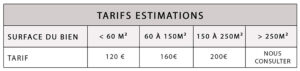
Here are the agency’s fees based on the size of your property. Feel free to compare, and remember: this fee will be refunded if you sell through the agency.
Conclusion
In a ski resort, estimating a property’s value requires careful attention and much more than a simple calculation per square metre.
As you can imagine, each property is unique, and many factors can influence its value.
A professional real estate appraisal allows you to position your property correctly from the outset, helping to make the sale faster and easier.
Keep in mind that an on-site appraisal can never be replaced by a free online automated valuation tool that does not take into account the specific characteristics of each property.

